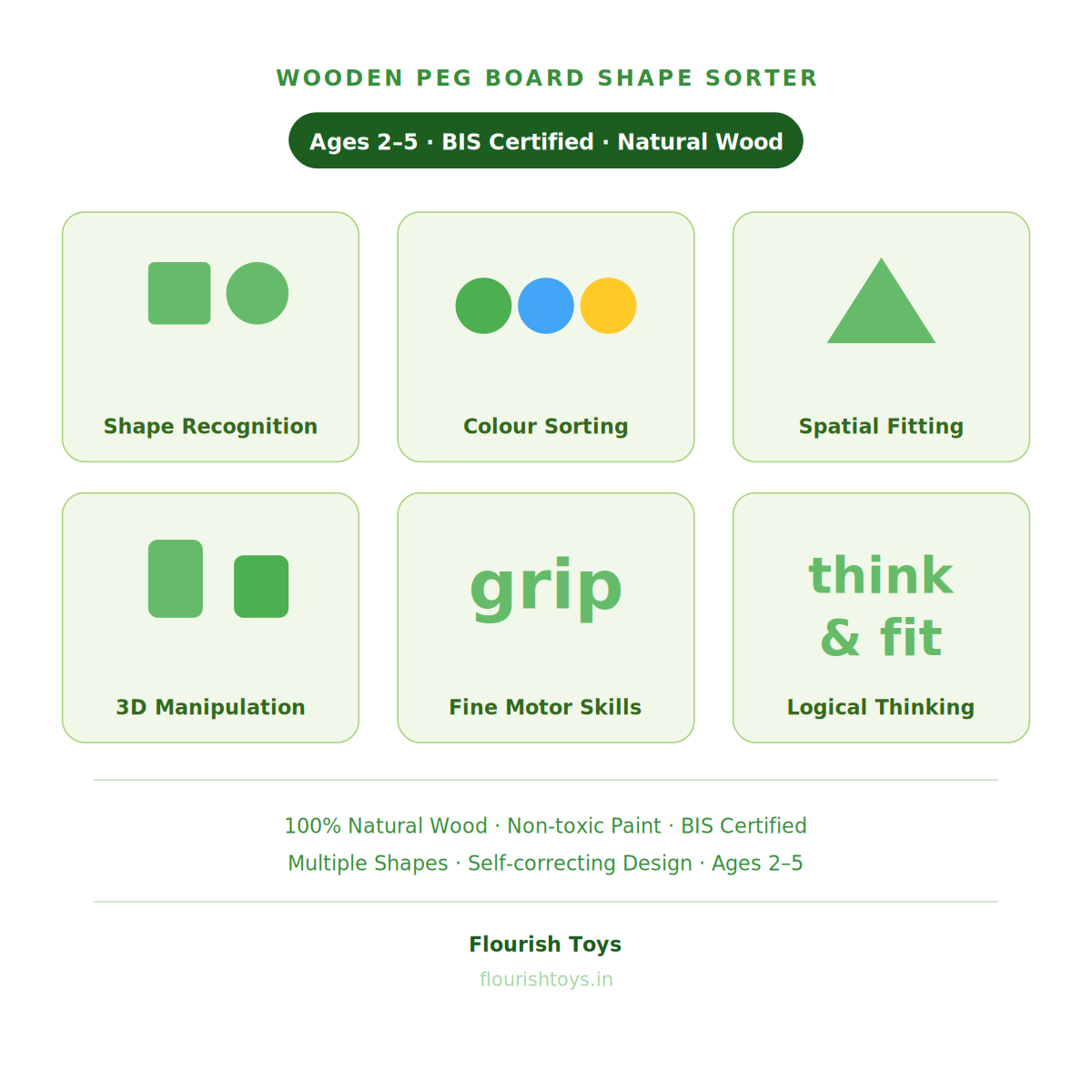
Wooden Peg Board Shape Sorter | Ages 2–5 | Shape & Colour Sorting
Wooden Peg Board Shape Sorter | Ages 2–5 | Shape & Colour Sorting
🎉 First order? Use code WELCOME10 for 10% off!
Couldn't load pickup availability
📦 Order before 3 PM → dispatches same day · Delivered in 3–5 business days · Free shipping on this order
🔒 Secure Checkout · 💳 UPI, Cards & Net Banking · ↩️ 7-Day Returns
Pick it up. Turn it. Find the slot. Push it in. Feel the click.
That four-step sequence — repeated dozens of times, across every shape, every colour, every session — is building the spatial reasoning, fine motor control, and logical thinking your child will use for the rest of their life.
→ True 3D objects — cylinders, cubes, cones — not flat pieces
→ Self-correcting — the wrong shape simply doesn't fit
→ Colour sorting adds a second layer of challenge
→ Sized and weighted perfectly for toddler hands
→ Toxin Free · Splinter-free
🎮 How to Play
🎮 How to Play
 Step 1 — Show & Name
Place a block and say its name. Your child watches, listens and internalises through repetition.
 Step 2 — Feel & Build
Your child picks up a block and stacks it. Weight, balance and gravity teach physics intuitively.
 Step 3 — Imagine & Create
Castles, bridges, cities — no rules, no limits. Every build grows their confidence and creativity.
📦 What's Included
📦 What's Included
94 wooden building blocks — arches, columns, triangles, half-circles & more
Alphabet blocks with clearly printed letters
Sturdy storage-friendly box
📐 Product Details
📐 Product Details
Material: 100% Natural Solid Wood
Paint: Non-toxic, lead-free, water-based
Pieces: 94 wooden blocks
Age: 3–8 years
Safety: BIS Certified · Splinter-free
Packaging: Sturdy storage box
🚚 Shipping & Returns
🚚 Shipping & Returns
Free shipping on orders above ₹499 · PAN India
Order before 3 PM → dispatches same day
Delivery in 3–5 business days
Easy returns within 7 days of delivery
Prepaid orders only — UPI, Cards & Net Banking accepted
🎁 Gift This Product
🎁 Gift This Product
Ships gift-ready in our kraft box
Add a free personalised message at checkout
For bulk or school orders (10+ pieces) WhatsApp us for wholesale pricing
Frequently Asked Questions
Frequently Asked Questions
How is this different from a flat shape sorter? The Peg Board uses true 3D objects — cylindrical, cubic, and conical pegs that must be understood in three dimensions, creating a richer cognitive challenge.
Can a 2-year-old use this independently? Yes — the self-correcting design means the board gives its own feedback. Play alongside in early sessions to name shapes and colours, then step back as confidence builds.
How do I clean it? Wipe with a damp cloth and mild soap. Avoid soaking in water.
Can I order this as a gift? Does it come gift-wrapped?
Can I order this as a gift? Does it come gift-wrapped?
Yes. Every Flourish toy ships in our premium kraft box — gift-ready straight out of the parcel. Add a free personalised message at checkout. For birthday return gifts or bulk school orders (10+ pieces) WhatsApp us for special pricing.
How long will delivery take? Do you deliver to my city?
How long will delivery take? Do you deliver to my city?
We ship PAN India — every city, every pin code. Orders placed before 3 PM are dispatched the same day. Standard delivery is 3–5 business days. You'll receive a tracking link via SMS once your order ships.